Replace your tube of toothpaste with!



Ingredients to Avoid in Toothpaste
Learn about the ingredients to avoid in toothpaste and find out how to choose a safer, gentler formula that supports your daily oral health. Make informed choices for a healthier smile.
BLOG POSTS
Luigi Cellini
5/13/20265 min read
Prefer to read this article in Spanish?
Read the Spanish version →
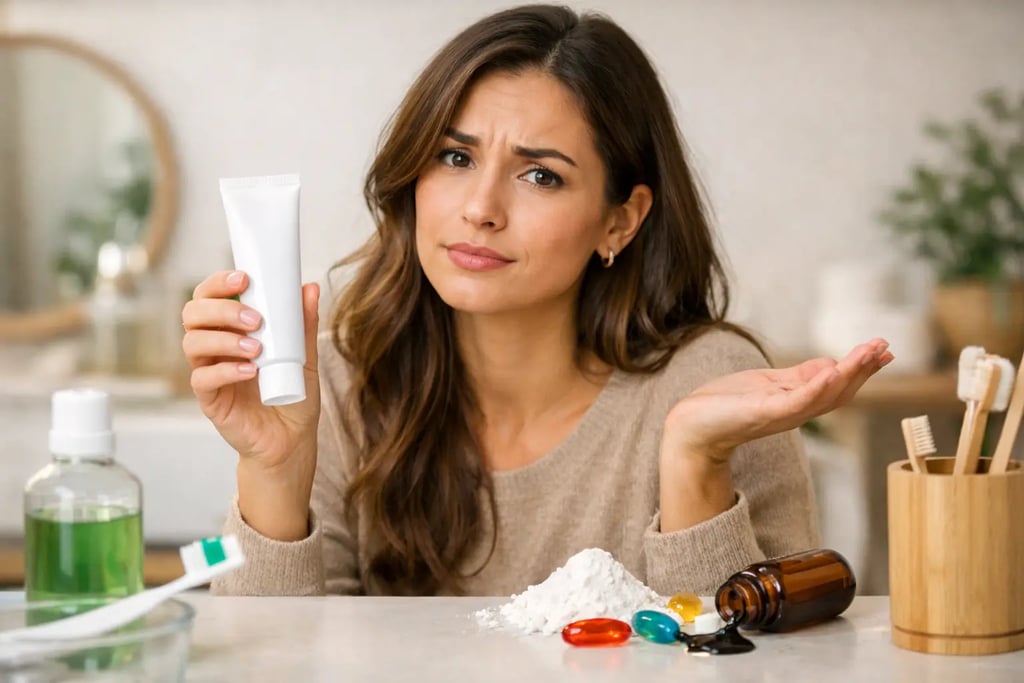
You brush two or three times a day, every day, for years. And yet, many people don't know which ingredients to avoid in toothpaste because they assume that if it's on the shelf, it must be harmless. That's the big mistake: conventional toothpaste isn't always formulated with biocompatibility in mind, but rather with texture, foam, preservation, and commercial appeal.
The mouth is not just any surface. It's a living, highly absorbent mucous membrane, with delicate gum tissue and a bacterial balance that deserves respect. That's why it's not enough for a toothpaste to "clean." How it cleans, with which agents, and what it leaves behind after each brushing also matter. If a formula irritates, dries out, or repeatedly alters the oral environment, the problem may not be visible on the first day, but it can eventually make itself known.
Which ingredients to avoid in toothpaste if you're looking for safer oral hygiene
Not all mouths react the same way, and that nuance matters. Some people with sensitive gums, recurrent canker sores, dry mouth, or a tendency toward irritation notice right away when a toothpaste doesn't agree with them. Others take longer to connect their discomfort with the toothpaste they use daily. Even so, several ingredients deserve critical scrutiny.
Sodium lauryl sulfate and other harsh foaming agents
One of the most questioned is sodium lauryl sulfate, also known as SLS. Its main function isn't to care for teeth or gums, but to generate foam and lift debris. The problem is that this foam, which consumers associate with "cleanliness," can be aggressive to sensitive mucous membranes.
In predisposed individuals, SLS can promote irritation, a burning sensation, or dryness. Some also link it to a higher frequency of canker sores. This doesn't mean that any contact is automatically harmful in all cases, but it does suggest caution with a formula that prioritizes cosmetic experience over oral balance. A toothpaste can clean well without needing to foam like a detergent.
Triclosan, chlorhexidine, and indiscriminate use of antibacterials
For years, the idea was sold that the more antibacterial a toothpaste, the better. That approach oversimplifies a delicate matter. The mouth doesn't need to be sterilized. It needs balance.
Triclosan has been one of the most controversial ingredients in this area. Its presence in personal care products sparked widespread debate due to its potential impact on the microbiome and safety concerns that led to restrictions in various contexts. For daily hygiene, using potent antimicrobials continuously doesn't always make sense.
A similar situation applies to chlorhexidine, though with an important nuance. It's a useful active ingredient in specific situations and under professional guidance, for example after surgery or in targeted treatments. Using it as an indefinite routine is a very different matter. It can stain, alter taste, and unbalance oral flora if used without real need.
Local anesthetics to "soothe" without solving
Some formulas include ingredients with a soothing or anesthetic effect to reduce gum discomfort. At first glance, this might seem like an advantage, but we need to ask an uncomfortable question: do we want to care for our gums or silence the signal that something is wrong?
The daily use of anesthetics in a toothpaste can mask a problem instead of correcting it. If a formula irritates and then adds a component to dampen that irritation, we're not looking at an elegant solution. We're looking at a patch. Quality oral hygiene shouldn't need to numb the mouth to be tolerable.
Unnecessarily harsh preservatives and antifungal agents
The tube format requires working with water, humectants, and more complex preservation systems. This brings in certain preservatives and antifungal agents that, while serving a technological function, aren't always the best news for sensitive mucous membranes.
Not all preservatives are the same, nor do they all pose the same risk. But the more complex and artificial a formula, the more likely it is to include ingredients designed to keep the product stable, not to respect the oral environment. This is one reason many people are looking differently at anhydrous or powder formulas: by eliminating water, the need for preservatives drops dramatically.
Abrasive ingredients: when whitening comes at a cost
Another category that deserves attention is abrasives. Here, there's a fine balance. Every toothpaste needs some degree of abrasiveness to help remove plaque and surface stains, but excessive abrasion can wear down enamel, irritate gums, and increase sensitivity.
The problem is that many products are sold on promises of rapid whitening and an intense polished feel. That "squeaky" sensation after brushing is sometimes interpreted as deep cleaning, when in reality it may indicate an action that's too aggressive for daily use. Healthy whiteness isn't achieved by sanding the tooth.
It depends on the type of abrasive, its particle size, its shape, and the overall formula. That's why reading just one isolated ingredient isn't enough. Some toothpastes that seem gentle in their marketing aren't so gentle in practice. Others, especially well-formulated ones, manage to clean effectively without punishing the tooth and gum structure.
Fluoride: the debate isn't settled with slogans
Talking about which ingredients to avoid in toothpaste inevitably means mentioning fluoride, but without caricatures. Some consumers wish to avoid it for consistency with a cleaner routine and out of caution regarding cumulative exposure. There are also professionals who defend it for its role in caries prevention in certain contexts.
The reality is that not everyone has the same needs or the same level of risk. An adult with a good diet, rigorous hygiene, and regular dental check-ups values a formula differently than someone with a high incidence of cavities. In children, moreover, concerns about accidental ingestion lead many families to seek safer, simpler alternatives.
The reasonable approach is to choose deliberately, not out of habit. If someone wants to reduce exposure to controversial ingredients and commits to consistent hygiene, a fluoride-free formula can fit perfectly within a broader preventive strategy. What doesn't make sense is assuming there's only one valid path for all mouths.
How to read a label without getting lost in marketing
Conventional brands have perfected the art of selling sensations: extreme freshness, total protection, advanced repair, instant whitening. But the ingredient label often tells a different story. When reviewing a toothpaste, it's wise to look beyond the front claim and ask yourself what real function each component serves.
If the formula relies on harsh foaming agents, permanent antibacterials, anesthetics, complex preservatives, and intense abrasives, you may be looking at a product designed to impress, not to respect. The longer and more overloaded the list, the more important it is to distinguish between functional ingredients and pure industrial cosmetics.
In contrast, a straightforward formula with few ingredients and a clear logic for daily use is usually more transparent. That alone doesn't guarantee excellence, but it does reflect a much more honest philosophy: clean without attacking, protect without overloading, and care without disguising.
The alternative isn't going backward, but choosing better
More and more consumers are leaving the traditional tube behind not because of a trend, but out of common sense. If a product comes into daily contact with such sensitive tissues, it's reasonable to demand a cleaner, simpler formula that is less dependent on harsh chemicals. That demand isn't radical. What has been radical is normalizing questionable ingredients for decades simply because the market made them the standard.
In this shift of perspective, powdered toothpaste has opened an interesting path. By eliminating water and simplifying the formulation, it can do without many of the additives common in conventional pastes. And if it's formulated with technical expertise, it doesn't have to sacrifice effectiveness or the feeling of real cleanliness. Blancodent is moving precisely in that direction: daily oral hygiene that is gentler, more consistent, and less subject to the logic of the tube.
Choosing well doesn't mean chasing perfect labels or falling into automatic fear. It means understanding what you put in your mouth every day and deciding whether that formula works for your oral health or just for habit. Next time you pick up your toothpaste, don't look first at what it promises. Look at what it contains.
A more natural smile for a cleaner world.
Information

Contact
Useful links