Replace your tube of toothpaste with!



Powder toothpaste vs Tube Toothpaste: Is the Switch Worth It?
Discover the benefits of powder toothpaste and whether switching from tube toothpaste is the right choice for your oral hygiene. Explore the advantages of natural powder options for a more conscious and effective dental care routine.
BLOG POSTS
Luigi Cellini
5/8/20245 min read
Prefer to read this article in Spanish?
Read the Spanish version →
There’s a gesture repeated two or three times a day without much thought: open a tube, squeeze, brush and spit. The problem is that this perfectly normal routine doesn’t necessarily mean better care. Natural powder toothpaste questions that automatism. Not as a trend, but as a serious alternative for those who want to clean their mouth without relying on unnecessarily complex formulas.
The question isn’t whether the powder format sounds different. The real question is whether it offers something meaningfully different. And that’s where it’s worth looking beyond the packaging and starting with the formula.
What really changes with a natural powder toothpaste
Conventional toothpaste has accustomed consumers to associating efficacy with foam, intense flavour and creamy texture. But foam alone doesn’t clean, nor does a tube guarantee better oral hygiene.
A natural powder toothpaste starts from a different logic. It can favour a shorter, more understandable composition, focused on the ingredients considered necessary for oral hygiene. That matters because the mouth is not just any surface: it is a sensitive biological environment exposed every day to everything we put into it.
When a formula eliminates what it considers unnecessary, the selection criteria become more demanding. It’s no longer enough to taste like mint and leave an intense feeling of freshness. It has to clean well, be gentle on the gums and help maintain a comfortable oral environment without adding components that the formulation doesn’t need.
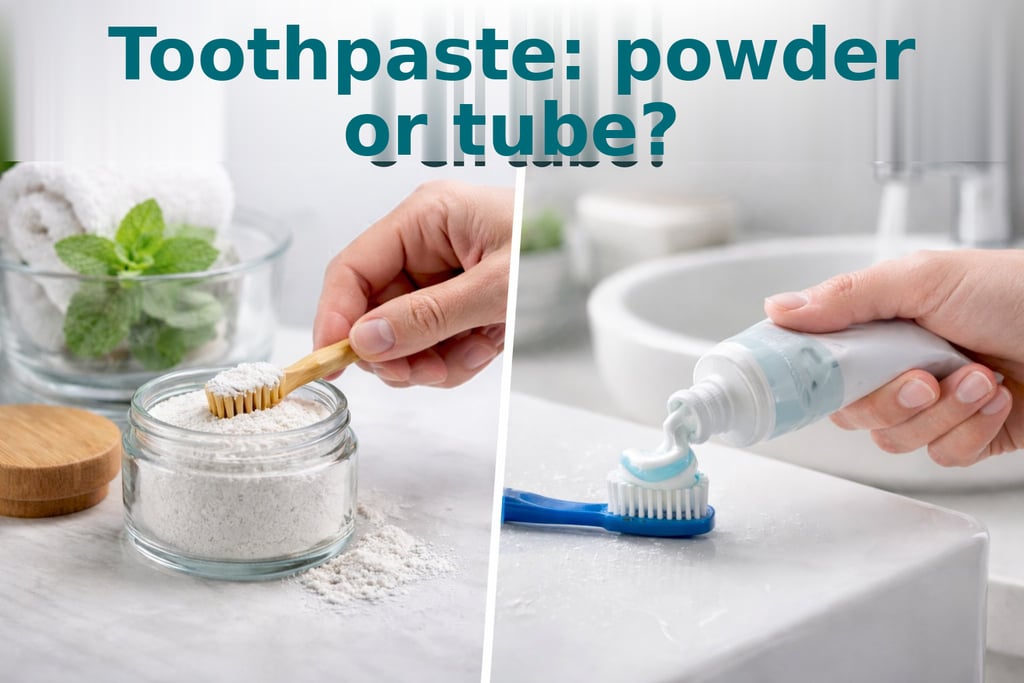
Tube toothpaste versus natural powder toothpaste
The contrast isn’t merely aesthetic. It’s also about formulation.
A toothpaste containing water needs a formulation capable of maintaining its consistency, stability and characteristics throughout its useful life. Depending on the formula, this can involve functional components such as humectants, stabilisers, preservatives, foaming agents and others.
Blancodent starts from a different approach: if a component isn’t necessary for our formula, we prefer to leave it out.
The powder format reduces the dependence on an aqueous phase. By dispensing with water, it allows a different and potentially simpler formulation. For consumers who prioritise transparency and want to reduce unnecessary components in their daily routine, that is not a minor detail. It is one of the reasons for choosing a powder.
That said, not every powder is automatically better. This is an important distinction. There are poorly formulated powder toothpastes, just as there are conventional pastes that are more carefully formulated than others. What matters is the quality and characteristics of the ingredients and the balance between cleaning, abrasiveness and gum tolerance.
The ingredient matters more than the format
If we’re going to talk about natural powder toothpaste seriously, we also need to talk about its mineral base. Bicarbonate is one of the best-known ingredients in oral hygiene, but not every bicarbonate-based formulation behaves in the same way. Particle size, physical characteristics and processing can influence how a formulation behaves during brushing.
A formulation based on what Blancodent’s developers call sublimated bicarbonate, for example, involves a relevant difference. According to its developers, Blancodent’s so-called sublimation process is the result of years of development and observation and does not consist simply of very fine grinding. It also involves a specific order in which the ingredients are incorporated and particular processing conditions that form part of its manufacturing method.
The result is an extremely fine mixture designed to distribute evenly over the teeth and gums during brushing and to behave differently from ordinary sodium bicarbonate used directly on the teeth.
This nuance matters because one of the usual concerns about powder toothpaste is the fear that it might “scratch”. It’s a legitimate concern, but it depends on the specific product. A poorly calibrated homemade mixture is one thing; a formulation developed for daily use, with attention to texture, dispersion and behaviour in the mouth, is quite another.
What drives someone to leave the tube behind
Those who switch from conventional toothpaste to natural powder toothpaste don’t usually do it on a whim. They may do so because they have started questioning the complexity of products they use in their mouth every day, just as many people already pay closer attention to what they eat or apply to their skin.
Several motivations can drive that change. The first is the reassurance offered by a formula conceived with the possibility of accidental ingestion during brushing in mind. The second is the decision to leave out certain ingredients when they are not considered necessary. The third is the desire for effective cleaning without aggressive brushing. And the fourth is a precautionary approach: reconsidering what we use every day rather than waiting for a reason to do so.
For many families, another consideration can be particularly important: finding a formula they feel comfortable using as part of the oral hygiene routine of different members of the family. It doesn’t mean that there is one toothpaste suitable for everyone, but reassurance in the event of accidental ingestion during brushing can understandably influence the choice.
When a natural powder toothpaste is worth considering
It may be worth considering when you’re looking for more than simply another way to brush your teeth: when you want a simpler formula and greater awareness of the ingredients that come into contact with your mouth every day.
It can also appeal to people who dislike excessive foaming, intense flavours or the sensation left by certain conventional toothpastes, as well as those who prefer simple but carefully developed formulations.
But something important needs to be said: switching to a powder and expecting miracles is not enough. Oral hygiene still depends on brushing technique, frequency, diet and the individual condition of teeth and gums. A toothpaste is part of that routine; it does not replace good brushing habits or professional dental care when needed.
What to check before choosing a natural powder toothpaste
The first thing to look at is not the marketing, but the formula. It’s worth checking whether the ingredients are clearly identified and whether their presence is coherent with the product’s purpose.
It also matters whether the brand clearly explains why it uses each ingredient and what role it plays. No one needs a chemistry textbook to choose a toothpaste, but genuine transparency matters.
Another key point is the experience of use. A good powder toothpaste shouldn’t feel coarse or leave the mouth uncomfortable. It should distribute well during brushing and leave the mouth feeling clean and fresh, not punished. If the experience is unpleasant, users are unlikely to continue using it, however convincing the theory may sound.
Professional experience can also provide useful additional context. Opinions and observations from dentists and other professionals can be valuable, particularly when they are clearly presented as professional experience rather than as a substitute for scientific evidence.
The mistake of confusing natural with insufficient
Natural doesn’t automatically mean better, just as conventional doesn’t automatically mean worse. What matters is the formulation.
But choosing a natural approach doesn’t necessarily mean accepting an ineffective one. A carefully developed powder toothpaste can pursue effective daily cleaning while following a different formulation philosophy.
Blancodent’s philosophy is simple: if we can formulate a product for oral hygiene without certain components, we prefer to leave them out. The fact that an ingredient may be authorised for a particular use does not mean that it has to be part of our formula. When we can avoid adding something we don’t consider necessary, we prefer not to add it.
For people who want to pay closer attention to what they use every day, this difference can matter.
A small revolution, but a daily one
Oral hygiene doesn’t change with grand speeches. It changes through repeated daily decisions. That’s why the format matters less than understanding what you are choosing and why.
Blancodent follows a different formulation philosophy: less emphasis on foam, intense flavour and cosmetic effects, and more attention to what is actually considered necessary in the formula.
If you’ve long suspected that the same old tube doesn’t have to be the only answer, perhaps you don’t need a spectacular promise. You just need an honest question:
If oral hygiene can be approached with a simpler formula and fewer unnecessary components, why not consider a different way of doing it?
A more natural smile for a cleaner world.
Information

Contact
Useful links