Replace your tube of toothpaste with!



Natural Remedies for Oral Hygiene: What Works
Discover effective natural remedies for oral hygiene that truly work. Learn essential oral hygiene tips and how to care for teeth and gums naturally without harsh chemicals.
BLOG POSTS
Luigi Cellini
5/1/20265 min read
Prefer to read this article in Spanish?
Read the Spanish version →
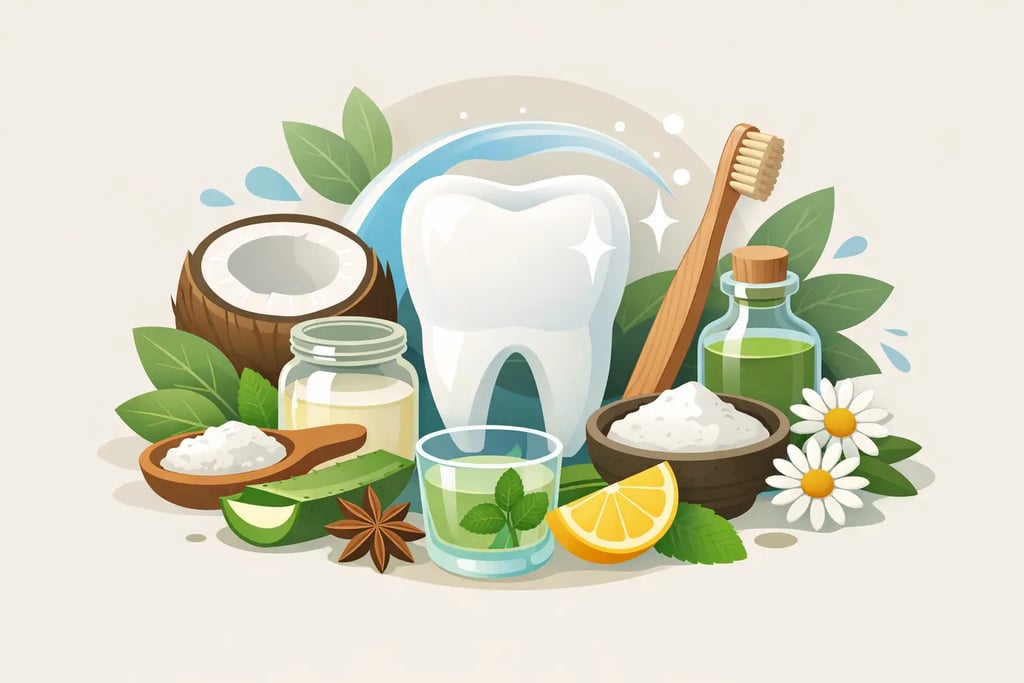
Most people don't need more foam in their mouth. They need less aggression, fewer questionable ingredients, and more judgment. When talking about natural remedies for oral hygiene, it's helpful to separate two things that are often mixed together: what sounds good on social media and what actually helps keep teeth, gums, and mucous membranes in balance.
Natural oral hygiene does not consist of improvising with whatever household ingredient. It consists of using formulas that are compatible with the mouth, effective at cleaning, respectful of gum tissue, and free from substances that provide no real value. That is the starting point. If a product cleans but irritates, numbs, or alters the oral environment, it is not a smart solution. It is a commercial patch.
What Natural Oral Hygiene Really Means
Natural should not be synonymous with weak, nor with artisanal without judgment. A well-planned natural oral hygiene aims to clean biofilm, reduce waste buildup, respect oral pH, and support tooth and gum structure without resorting to unnecessary harsh agents.
This is where much of the conventional offering fails. Many toothpastes have normalized foaming agents, preservatives, and additives that consumers accept because they've been on the shelves for decades, not because they are the best option. Foam gives a feeling of cleanliness, but the feeling does not equal the result. The same goes for extremely intense flavors or formulas that leave the mouth numb. The spectacular sells. The biocompatible protects.
That's why talking about natural remedies for oral hygiene is not just about plants or homemade recipes. It's about a routine that does not intoxicate, does not irritate, and does not rely on gimmicks to appear effective.
Natural Remedies for Oral Hygiene That Actually Make Sense
The first is baking soda, but not just any way. Well formulated, with appropriate particle size and designed for daily oral use, it can help clean, neutralize acids, and promote a feeling of a genuinely clean mouth, not a cosmetic one. The problem is not the ingredient itself, but the format. A coarse, poorly integrated baking soda used harshly can be uncomfortable or unpleasant. When worked with precision, it completely changes.
Fine sea salt has also been traditionally used as a support for occasional rinses, especially when there is gum sensitivity or localized discomfort. However, occasional use is one thing; making it the sole basis of cleaning is another. Salt can accompany, but it does not replace complete hygiene.
Some clays of cosmetic or oral quality are incorporated into natural formulas for their adsorptive capacity and mineral profile. Here again, there are nuances. Not all clays are suitable, not all have the same fineness, and not all are pleasant for daily use. When the mineral discourse is abused without caring for formulation, the result can be rough and inconsistent cleaning.
Essential oils deserve a more serious look than what is usually seen in marketing. There are botanical actives with clear benefits for freshening breath or supporting oral balance, but in poorly adjusted concentrations they can irritate. Natural does not mean harmless by default. If a formula relies too heavily on aromatic impact, it is probably prioritizing sensation over tissue health.
Oil pulling with coconut oil is also widely used. It can provide a feeling of dragging and freshness, and some people integrate it well into their routine. But it should not be sold as a substitute for brushing. It is a complement, not a complete solution. If you don't remove plaque properly afterward, the problem remains.
Natural Can Also Be Poorly Conceived
The great mistake of the alternative market is thinking that everything homemade is automatically better. It is not. Lemon, for example, frequently appears in home advice for whitening teeth. That is a bad idea. Its acidity compromises enamel and turns a supposed solution into a factor of wear.
Activated charcoal is another revealing case. It has become popular due to its radically black image and the promise of visible whiteness. It looks great in a visual campaign, but that is not enough to recommend it without reservations. Depending on particle size, frequency, and overall formulation, it may not be the best option for a prolonged daily routine.
Something similar happens with vinegar. Being natural does not give it permission to enter the mouth as a regular hygiene tool. Its acidic profile does not favor enamel. And if there's anything a responsible oral routine should avoid, it's slow wear that later results in sensitivity and structural deterioration.
In other words: the natural is not defended by romanticism. It is defended when it demonstrates compatibility, efficacy, and safety of use.
The Problem with Conventional Toothpaste Is Not Just the Tube
Reducing criticism of traditional toothpaste to the packaging would be staying on the surface. The real problem lies in the formulation logic. The industry has built products heavily focused on the commercial experience: abundant foam, strong flavor, homogeneous texture, long shelf life, and immediate sensation. All of this may facilitate sales and habit, but it does not always align with what a mouth needs every day.
Many people seek to move away from that model because they are tired of ingredients they don't understand, formulas that dry out, or products that their children end up accidentally swallowing. And that concern is reasonable. If a toothpaste comes into daily contact with such sensitive mucous membranes, demanding [formula cleanliness](https://www.blanco-dent.net/pasta-de-dientes-sin-toxicos-que-mirar) is not extremism. It is common sense.
A well-designed [natural tooth powder](https://www.blanco-dent.net/pasta-de-dientes-en-polvo-natural) changes the approach. It eliminates unnecessary water, reduces the prominence of foaming agents, and places the weight on functional ingredients. This forces better formulation. It is no longer enough to mask the experience. You have to offer real cleaning, stability, and oral tolerance.
How to Choose Natural Remedies for Oral Hygiene Without Falling for Empty Promises
The first question is not whether a product is natural, but whether its composition makes oral sense. It is advisable to check whether it contains harsh ingredients, whether its abrasivity seems reasonable, and whether its daily use is designed for gums and enamel, not just for green marketing.
The second is whether it serves as a real substitute or as a nice complement. A homemade rinse can accompany. An oil can add. An infusion can refresh. But if in the end you still depend on a conventional toothpaste full of questionable additives, you haven't changed the underlying problem.
The third is whether the formula is sustainable in practice. A natural remedy only truly works if you can stick with it. It must clean well, leave a feeling of a healthy mouth, be pleasant to use, and fit into your daily routine. If it requires long rituals or yields ambiguous results, consistency breaks down.
This is where a proposition like Blancodent clearly finds its place: not as a naturalist eccentricity, but as a direct alternative to the conventional tube. Its approach of an edible tooth powder, [fluoride-free](https://www.blanco-dent.net/dentifrico-sin-fluor-que-mirar-de-verdad) and without harsh substances, responds to a very specific demand from informed consumers: to clean without intoxicating and to care without punishing.
An Effective Natural Routine Is Simple, Not Improvised
The best routine is not the most complicated, but the most consistent. Careful brushing two or three times a day, attention to the gum line, interdental cleaning when needed, and an oral formula that does not turn every use into unnecessary exposure to dubious compounds. That already makes a huge difference.
If there is also a tendency toward gum inflammation, sensitivity, or dryness, further fine-tuning is advisable. Not all mouths tolerate the same ingredients equally. Some people benefit from more mineral and sober formulas. Others need to avoid intense essential oils as much as possible. Properly understood natural hygiene does not impose blind dogmas. It adjusts.
Diet also matters, although some brands prefer not to go there because it sells less than an instant promise. Frequent sugars, constant snacking, and acidic beverages complicate any routine, no matter how natural the toothpaste. Prevention lies not only in what you put on the brush, but in what you stop normalizing throughout the day.
The decisive thing is this: the mouth does not need more artifice, it needs more respect. Choosing natural remedies for oral hygiene is not going backward or falling for homemade fads. It is moving toward cleaner, more conscious, and more demanding hygiene regarding what we accept as normal. When you change the logic of oral care, not only does your brushing change. The standard by which you protect your health every day changes as well.
A more natural smile for a cleaner world.
Information

Contact
Useful links