Replace your tube of toothpaste with!



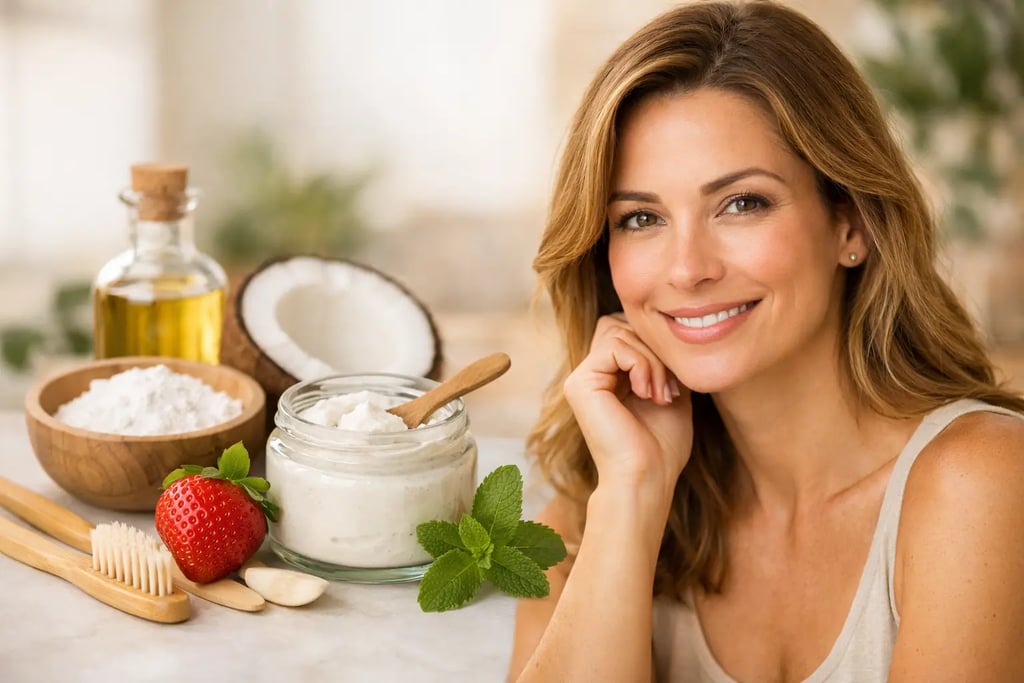
Natural edible toothpaste: what's worth it
Natural edible toothpaste: what to look for before using it, what to avoid compared to conventional toothpaste, and when it might be a safer option.
BLOG POSTS
Luigi Cellini
6/5/20266 min read
Prefer to read this article in Spanish?
Read the Spanish version →
There's an uncomfortable moment that many people no longer want to ignore: you brush two or three times a day with a toothpaste that you would never eat, even though some of it always ends up in your mouth. That's where natural edible toothpaste stops sounding like a trend and starts making sense. If a product is designed for daily use, in an area as absorbent as the oral cavity, the right question isn't just whether it cleans. The question is what it leaves in contact with your teeth, gums, and mucous membranes, and what happens when you swallow a small amount every day.
What a natural edible toothpaste really is
It's not enough for it to say "natural" on the label, or for it to taste good. A well-designed natural edible toothpaste is a formula intended for oral hygiene without harsh ingredients, without superfluous additives, and without compounds that come with the implicit warning "better not swallow it". The basic idea is simple: if it's going into your mouth every day, it should be biocompatible, gentle, and reasonable even in the case of accidental ingestion.
That changes the whole approach compared to [conventional toothpaste in a tube](https://www.blanco-dent.net/alternativa-saludable-a-pasta-en-tubo). Classic industrial logic has prioritised texture, foam, long shelf life, strong flavour, and mass production. The result is often a mixture where the commercial experience weighs more than physiological compatibility. It cleans, yes. But cleaning shouldn't mean subjecting your mouth to harsh surfactants, questionable preservatives, or formulas loaded with fillers.
The problem with conventional toothpaste isn't just one thing
We've normalised a toothpaste that foams a lot, numbs sensitivities, incorporates agents of questionable action, and needs stabilisers to remain usable for months or years inside a tube. That standard is sold as progress, when often it's just industrial formulation adapted to the consumer channel.
Foam, for example, is perceived as cleaning. But a clean mouth doesn't need to foam as if it were shampoo. An extreme feeling of freshness is also interpreted as effectiveness, even though it sometimes just masks irritation or sensitivities. And the tube, which seems practical, forces a wet formula that usually requires more chemical intervention to remain stable.
To be fair: not every conventional toothpaste is equally bad, nor is every natural product automatically better. There are well-made formulas and opportunistic ones on both sides. But when a natural, edible toothpaste is formulated with care, it starts with an important advantage: it reduces daily exposure to unnecessary substances.
Why the [powder format](https://www.blanco-dent.net/dentifrico-en-polvo-o-en-tubo) changes the game
Powder isn't a novelty. In fact, it's a more direct and less processed way to formulate a toothpaste. By removing water from the equation, much of the need for preservatives, stabilisers, and textural tricks disappears. What's left can be much cleaner.
That doesn't mean any powder works well. Some are too abrasive, others fall short on cleaning, and others are unpleasant to use. Quality depends on the type of minerals, particle size, and how they interact with gums and enamel. That's the real difference between a serious formula and a makeshift one.
A good tooth powder doesn't try to impress with foam. It aims to clean, respect oral balance, and support the tooth-gum structure without damaging tissues. That's a difference in philosophy, not just format.
Natural edible toothpaste and daily safety
When someone looks for a natural edible toothpaste, they're usually not looking for a luxury. They're looking for peace of mind. They want to know that if the product touches their tongue, gums, palate, and throat, it's not introducing a cocktail that's hard to justify. They want to be able to use it every day without that absurd contradiction of "it's for your mouth, but it's better not to swallow it".
This concern is even more logical in households with children, people with sensitive mucous membranes, or users who brush frequently. In those cases, tolerance matters a great deal. A gentle product, without harsh foaming agents and without ingredients of questionable toxic profile, isn't a luxury. It's sensible hygiene.
Now, "edible" shouldn't be taken as a free-for-all. It's not food, nor should it be used in absurd quantities. It means that its composition is designed to be safe for regular oral use and reasonable if a small amount is swallowed – which, in practice, happens.
Which ingredients make the difference
Natural oral hygiene isn't sustained by green marketing. It's sustained by formulation. And here, you need to focus on a few relevant things. First, which cleaning agents are used and how harsh they are. Second, whether the formula contains dispensable compounds designed more to sell sensations than to care for the mouth. Third, the real quality of the mineral base.
In a serious proposal, well-processed bicarbonate can play a central role because of its ability to clean, help balance the oral environment, and deliver a gentle action when properly formulated. Not just any bicarbonate or any texture will do. If the particle size is wrong, the experience worsens, and so does tolerance.
That's why a distinctive formula like sublimated bicarbonate makes sense within a technical vision, not just a commercial one. The goal isn't to include a well-known ingredient and stop there. The goal is to improve its behaviour in the mouth, its absorption, and its action on the tooth-gum structure. That's the kind of detail that separates a real alternative from a copy dressed up with nice words.
What it can offer and what shouldn't be promised
A well-formulated natural toothpaste can help clean effectively, reduce the burden of harsh substances, be more respectful of gums, and provide a feeling of a healthy mouth without resorting to artifice. It can also become a complete replacement for the tube if the user experience is consistent and the results follow.
What should not be done is to promise miracles. No toothpaste, on its own, fixes poor habits, sugar-heavy diets, bruxism, or advanced periodontal disease. Oral hygiene depends on the whole picture: brushing technique, frequency, diet, hydration, and professional check-ups when needed.
But that "it depends" shouldn't be used as an excuse to whitewash the usual products. That a toothpaste doesn't do everything doesn't mean all toothpastes are equivalent. They are not. Composition matters. The route of exposure matters. And repeated use over years matters.
How to tell if you're looking at a serious option or pure marketing
The test isn't in words like "eco", "bio", or "detox". It's in the [ingredient list](https://www.blanco-dent.net/composicion-dentifrico-natural-ingredientes), in the logic of the formula, and in the brand's transparency. If a product boasts about being natural but is still loaded with unnecessary additives, the problem remains. If the brand avoids explaining why it uses each ingredient, that's a bad sign. And if it all comes down to pleasant aroma and nice packaging, that's even worse.
A serious option talks about safety, continuous use, oral compatibility, and real function. It explains why it does without fluoride, foaming agents, antibiotics, anaesthetics, or anti-mould agents if that's its proposition. And it supports that decision with a coherent vision of preventive health, not empty slogans.
In this area, Blancodent has pushed an uncomfortable but necessary idea: if tube toothpaste requires you to accept ingredients you wouldn't willingly put in your mouth outside the context of brushing, maybe the format wasn't as untouchable as we were led to believe.
Who this alternative is best for
It's especially well-suited to adults who want to reduce exposure to questionable chemicals, people with oral sensitivity, those who prioritise simple formulas, and families looking for safer hygiene for the little ones as well. It also tends to convince users who have already made the switch in other personal care categories and don't see why the mouth should be the exception.
It doesn't fit as quickly for those who need a lot of foam to feel clean, or for those seeking artificially intense flavours. There's an adjustment period there. Sometimes it lasts two days; sometimes a couple of weeks. It's worth going through if the goal is to move from cosmetic hygiene to hygiene that is truly compatible with the physiology of the mouth.
Changing your toothpaste doesn't seem like an ideological decision until you look closely at the label. Then it stops being a minor gesture and becomes a daily choice between repeating an industrial habit or using something your mouth can recognise as sensible. If you're going to put a product into your routine two or three times a day, it had better do more than just clean: it had better make sense.
A more natural smile for a cleaner world.
Information

Contact
Useful links