Replace your tube of toothpaste with!



Ingredients to avoid in toothpaste
Discover the ingredients to avoid in toothpaste and why certain formulas can irritate gums, upset your mouth, and harm your daily use.
Luigi Cellini
5/17/20266 min read
Prefer to read this article in Spanish?
Read the Spanish version →
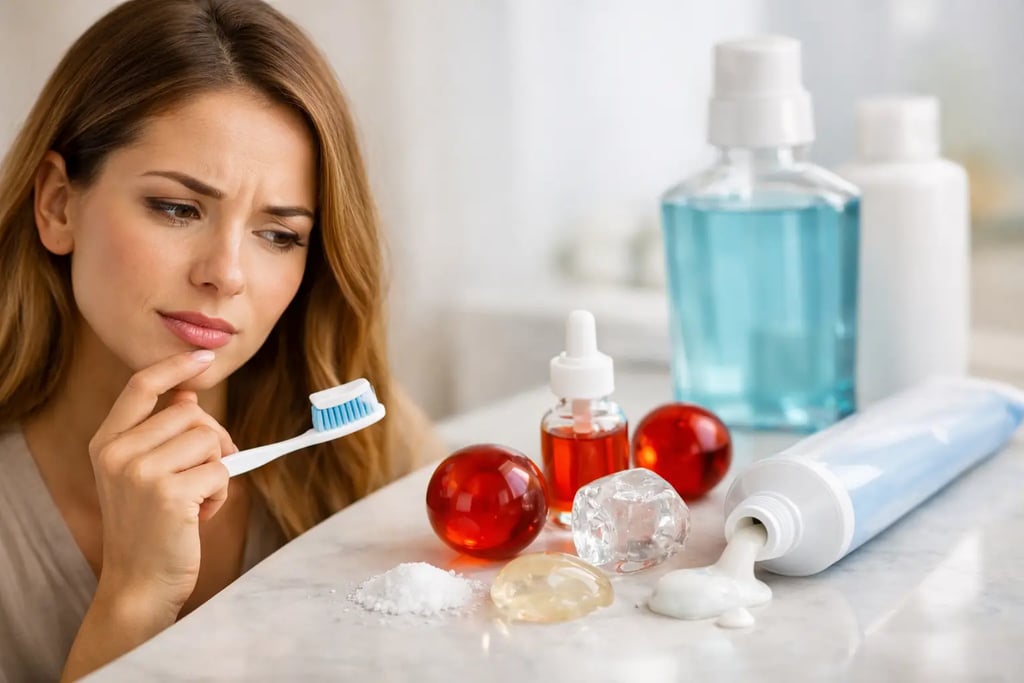
There is a gesture we repeat two or three times a day without giving it much thought: brushing our teeth. Precisely for that reason, it’s worth taking a closer look at the ingredients to avoid in toothpaste. When a formula comes into daily contact with gums, mucous membranes, and enamel, we are no longer talking about a technical detail, but a health decision.
For years, the industry has led many people to associate a dense, highly foaming, aggressively minty paste with superior cleaning. But that sensation does not always equate to more respectful oral hygiene. In fact, in many cases, the opposite is true: the more elaborate the formula, the more likely it is to include unnecessary, irritating, or hard-to-justify substances for daily use.
Ingredients to avoid in conventional toothpastes
Not all toothpastes are the same, and not all problematic ingredients act the same way. Some can cause irritation, others mask symptoms, others disrupt the natural balance of the mouth, and others simply serve industrial interests rather than genuine preventive logic.
Harsh foaming agents
If a toothpaste produces a lot of foam, it doesn’t mean it cleans better. In many cases, it means it contains strong surfactants designed to create a cosmetic sense of cleansing. The best-known is sodium lauryl sulfate (SLS).
The problem is not just its chemical name, but its function. This type of agent can dry out tissues, irritate sensitive mucous membranes, and be especially uncomfortable for people with recurrent canker sores, reactive gums, or dry mouth. Foam is convincing, but it also distracts. It makes you believe the product is working harder, when in fact it may be compromising daily tolerance.
Here’s an important nuance: not every user will experience immediate irritation. Some people tolerate it without obvious symptoms. Still, if you’re looking for gentle, sustained oral hygiene, it’s hard to justify the presence of harsh foaming agents when much more biocompatible alternatives exist.
Triclosan and other cosmetic antibiotics
For years, "antibacterial" formulas were marketed as if any reduction in bacteria were inherently positive. That approach is simplistic. The mouth doesn’t need sterilization; it needs balance.
Triclosan was used in personal care products with the promise of controlling plaque and gingivitis. The problem is that introducing a cosmetic antibiotic into a daily routine raises serious questions about disrupting the oral microbiota, unnecessarily using intense-acting agents, and cumulative exposure. When an ingredient acts with an indiscriminate sweeping logic, it’s worth asking whether it is truly caring for the oral ecosystem or forcing it.
Good oral hygiene should not depend on substances typical of an aggressive antimicrobial strategy. It should rely on mechanical cleaning, gentle formulations, and consistent habits.
Chlorhexidine out of context
Chlorhexidine has its place in specific, professionally guided contexts for limited periods. The mistake occurs when its presence or prolonged use is normalized as if it were a routine solution.
It is an effective ingredient in specific situations, yes, but it is not intended for uncontrolled daily hygiene. It can stain teeth, alter taste, and affect the oral bacterial balance if used beyond recommended limits. It’s the perfect example of an active ingredient that is valid in a clinical setting but should not be trivialized for everyday use.
Local anesthetics that mask the problem
Some toothpastes include soothing or anesthetic ingredients for sensitive gums or occasional discomfort. On paper, that sounds good. In practice, it can become a trap.
When a product numbs the area, the user may interpret relief as real improvement. But reducing the perception of pain is one thing; resolving the origin of inflammation, gum recession, or sensitivity is another. Masking the body’s signals is rarely a smart long-term strategy.
The mouth warns you. If we silence that warning with a repeated-use anesthetic, we delay addressing the underlying problem. An honest formula should care for the mouth without artificially silencing symptoms.
Which ingredients deserve special scrutiny
Beyond clearly controversial ingredients, there are others worth questioning because they are often part of highly processed conventional toothpastes. They are not always equally problematic in all cases, but they do justify a critical reading of the label.
Unnecessary preservatives and anti-mold agents
When a toothpaste contains water and remains open in a tube for months, it requires more complex preservation systems. This is where preservatives and anti-mold agents appear—substances that offer no direct benefit to oral hygiene but serve the industrial stability of the product.
That doesn’t mean any preservative is automatically dangerous. It means that the more a formula depends on artificially maintaining its commercial integrity, the more likely it is to carry ingredients that serve the packaging, not your mouth. Reducing water and simplifying the composition usually allows for cleaner, more straightforward, and understandable formulas.
Intense flavors and superfluous colorants
Extreme freshness sells. Bright colors also sell. But neither electric blue nor sharp flavor cleans better. In many toothpastes, flavors and colorants are there to enhance the consumer experience, not to improve the health of teeth and gums.
In sensitive individuals, these additives can be irritating. In children, they also increase the risk that the product is perceived as almost edible due to its sensory profile. And for adults concerned with a clean formula, they are a reminder of how much conventional oral care has prioritized perception over physiology.
Poorly balanced abrasives
Not everything that polishes is beneficial. A toothpaste can leave a smooth-surface sensation and still be too harsh if its abrasive system is not well calibrated.
This point requires nuance. A certain level of abrasiveness is useful for helping to remove plaque and surface stains. The problem arises when a quick whitening effect is sought at the expense of excessive wear. If enamel is already compromised, or if there is sensitivity or gum recession, an abrasive formula can worsen the situation. The sensible choice is not the product that scrubs hardest, but the one that cleans effectively without punishing the teeth and gums.
How to read a label without being impressed
The industry knows how to dress up its products. Words like "total protection," "intense action," or "antibacterial shield" sound convincing, but they don’t explain what you’re putting in your mouth every day. The label does.
If when reading the composition you find a long chain of hard-to-identify ingredients, it’s worth pausing. Not because every technical term is suspect, but because a daily formula should be able to justify its complexity with a real and reasonable function. When foaming agents, preservatives, colorants, potent antibacterial agents, and sensory correctors abound, the product begins to look more like an industrial construction than a respectful hygiene tool.
It’s also wise to distrust purely advertising-based authority arguments. That a toothpaste is mainstream does not make it the most sensible. And that a substance has been on the market for decades does not mean it’s the best option for a modern preventive routine.
The sensible alternative is not to embellish the formula, but to simplify it
True innovation in oral hygiene is not about adding more impactful chemicals, more foam, or more grand promises. It’s about returning to a cleaner logic: clean well, respect tissues, don’t poison the routine, and don’t turn the mouth into a laboratory of unnecessary exposure.
That’s why interest is growing in fluoride-free toothpastes, without harsh foaming agents, without cosmetic antibiotics, without anesthetics, and without anti-mold agents. It’s not a naive trend. It’s a response to an overload of ingredients that for too long have been presented as normal.
In this area, the format also matters. A well-formulated powdered toothpaste eliminates several constraints of the traditional tube, especially the dependence on water, complex preservatives, and certain stabilizers. If it also opts for a short composition and gentle actives, the change is not just one of texture. It’s a change of philosophy.
Blancodent has built precisely that rupture: a natural powdered oral hygiene proposal that challenges the idea that a healthy mouth needs chemical aggression to stay clean. Its approach is especially coherent for those who truly want to replace conventional toothpaste, not just alternate it occasionally.
Choosing better is also a form of prevention
Oral prevention does not begin when pain appears. It begins much earlier, in small, repeated decisions. Choosing a more respectful toothpaste does not by itself guarantee a healthy mouth—brushing technique, diet, mouth breathing, gum health, and professional check-ups also matter. But it does reduce unnecessary burden.
And that change matters. If you use something every day, several times a day, for years, it makes no sense to settle for a questionable formula just because it’s the usual one. Habit is not a scientific endorsement.
Next time you hold a toothpaste, don’t look first at the flavor, the whitening claim, or the foam it promises. Look at whether its formula truly respects the mouth it claims to care for.
A more natural smile for a cleaner world.
Information

Contact
Useful links