Replace your tube of toothpaste with!



How to Brush Teeth with Tooth Powder: Step by Step
Discover the step-by-step guide on how to brush your teeth with tooth powder. Learn effective and natural teeth cleaning techniques for healthier teeth and gums, while avoiding common mistakes.
BLOG POSTS
Luigi Cellini
5/12/20265 min read

Prefer to read this article in Spanish?
Read the Spanish version →
If, when opening a powdered toothpaste, you think it’s going to be more complicated than using a paste from a tube, the reality is usually the opposite. Understanding how to brush your teeth with dental powder doesn’t require a strange technique or an alternative ritual. It does require letting go of an industrial habit and rediscovering a simple, clean gesture that is far more consistent with daily oral health.
Conventional toothpaste has accustomed us to two rather questionable ideas: that lots of foam means thorough cleaning, and that a dense texture provides better protection. Neither of these defines good brushing. What really makes the difference is controlled friction, duration, formula quality, and respect for teeth, gums, and oral mucosa. This is where a well-formulated dental powder plays in a different league.
How to brush your teeth with dental powder, step by step
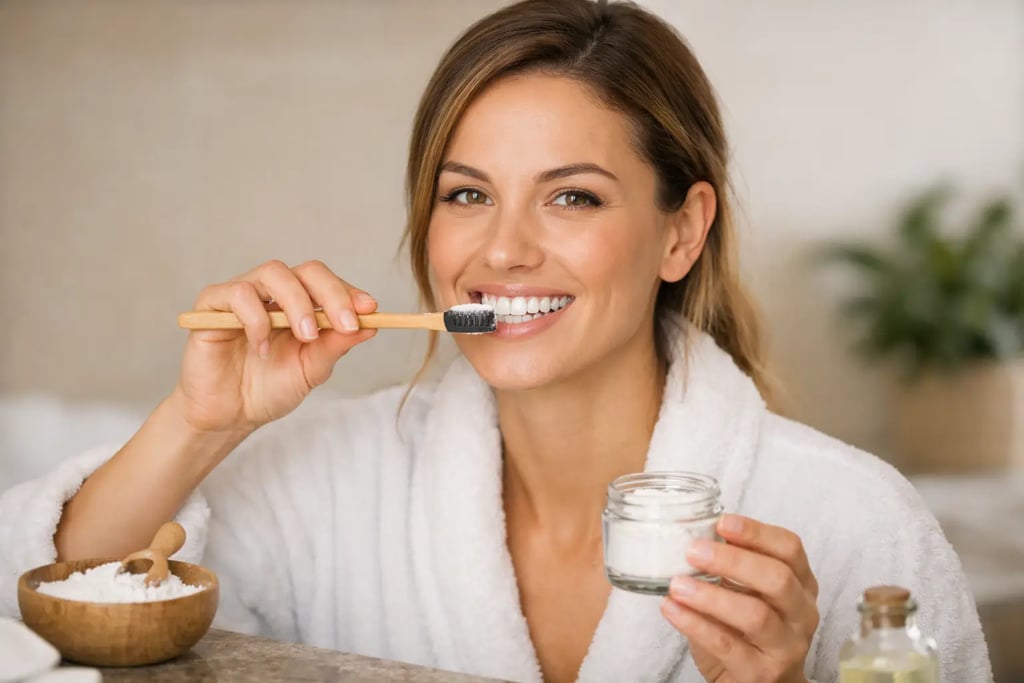
The technique is simple. First, lightly moisten the brush. You don’t need to soak it, because excess water clumps the powder and reduces its ability to spread well around the mouth. The brush should be just damp, not dripping.
Then, touch the powder with the tips of the bristles. You don’t need to load half the brush or create a thick layer. A small amount is usually enough. The most common mistake beginners make is using too much product out of habit, as if they were squeezing out paste. With powder, less is often more.
Once in your mouth, brush with gentle, short strokes, covering the outer, inner, and chewing surfaces of each tooth. You should also pay attention to the gum line, but without rubbing aggressively. Effective cleaning doesn’t come from scrubbing hard, but from maintaining moderate, steady pressure for about two minutes.
Finally, spit out and rinse if you wish, though this depends on the formulation and your preferences. Some people prefer a light rinse to leave a thin mineral film in the mouth. Others opt to rinse completely. If the formula is clean and gentle, both options can fit into your routine.
What changes compared to tube toothpaste
The most obvious difference is texture, but it’s not the most important one. The key thing is that dental powder does away with much of the cosmetic theater of conventional toothpaste. Less foam, fewer unnecessary excipients, less artificial feeling of extreme freshness. In return, it offers a more straightforward, more direct brushing experience, and when the formula is well designed, one that is more respectful of oral balance.
Many users initially notice that brushing feels different and interpret this as if it cleans less. In many cases, the opposite is true. We are so conditioned by foaming agents and harsh flavors that we confuse sensory stimulation with real hygiene. A clean mouth doesn’t need to look like a foam factory.
Dosage also changes. The tube encourages you to use too much. Powder, on the other hand, invites more careful measuring. This not only improves product performance but also reduces excessive abrasion on sensitive tissues. When it comes to daily oral care, sustained gentleness matters as much as immediate effectiveness.
Common mistakes when using dental powder
The first we’ve already seen: wetting the brush too much. The second is scrubbing forcefully, as if the powder needs to be compensated with pressure. No. If the formula is well balanced, the product does the work together with correct technique, not mechanical violence.
Another frequent mistake is judging it by foam. Some people brush for thirty seconds, see that it doesn’t foam like a commercial paste, and think it’s not working. In reality, what’s missing isn’t foam, but brushing time. Two minutes done properly remain the sensible benchmark.
It’s also wise to avoid contaminating the container. Ideally, the brush goes in dry or just barely damp, without leaving residues inside the jar. If you prefer maximum hygiene, you can pour a small amount onto a clean spoon or the lid before use. It’s not always essential, but it’s a good practice if several people share the product.
How to brush with dental powder if you have sensitive gums
Here, technique matters even more. Use a soft-bristled brush and avoid harsh horizontal movements. Inflamed gums don’t improve with punishment. They improve when irritation is reduced, plaque is controlled, and a consistent routine is maintained.
A good dental powder can be a particularly interesting option for those looking to move away from conventional formulas with questionable ingredients or those that are too aggressive for continuous use. Not all powders are the same, of course. It depends on formulation quality, particle size, and whether the ingredients are designed to work with oral physiology rather than imposing themselves on it.
That’s why you should be wary of both tube toothpaste marketing and certain poorly executed natural proposals. Natural doesn’t automatically mean effective or gentle. What matters is a formula that cleans, respects, and can be used daily without turning your mouth into a testing ground.
How much dental powder to use
Very little. This is one of the biggest advantages of the format. You don’t need to cover the entire brush head like in toothpaste ads—an image created to sell more product, not to educate better. A light coating on the bristle tips is usually enough for a complete brushing.
If you use too much, you’ll notice an unnecessary gritty feel and waste product. If you use too little, it may not spread well at the start. The right amount takes just a few days to learn. Adaptation is quick because the mouth quickly recognizes when something cleans without overwhelming it.
What to look for in a good powdered toothpaste
Here’s the crucial part. Learning to use it matters, but choosing well matters more. A serious dental powder should avoid superfluous or problematic substances and aim for a clean, stable composition suitable for continuous use. The industry’s obsession with foaming, perfuming, and numbing the experience has confused consumers for years.
A well-constructed formulation can help clean gently, support tooth and gum structure, and maintain a healthy mouth feel without resorting to gimmicks. In this area, work with sublimated bicarbonate stands out—a technical evolution compared to regular baking soda that improves absorption and offers a finer, more balanced behavior in the mouth. It’s not about putting powder in a jar and calling it innovation. It’s about truly redefining what it means to brush your teeth every day.
Blancodent has precisely raised that flag: replacing the tube with a safe, gentle powder alternative, free from a long list of unnecessary ingredients that mass oral hygiene has normalized for too long. The change isn’t aesthetic. It’s a matter of judgment.
Is it suitable for daily use?
Yes, as long as the formula is designed for it and brushing is done correctly. In fact, that’s the key: dental powder shouldn’t be reserved for occasional use or seen as an exotic supplement. If it works well, it should be able to replace conventional toothpaste in your daily routine.
That said, there are nuances. If you’re coming from a highly sensitized mouth, receding gums, or a history of brushing abrasion, observe how you respond during the first few weeks and check the pressure you apply with the brush. Sometimes the problem wasn’t the paste or the powder, but an aggressive technique maintained for years.
It’s also reasonable to consult a professional if you have braces, prosthetics, implants, or a specific oral condition. A good powdered toothpaste can fit in very well, but the final recommendation depends on the case.
What people who make the switch usually notice
The transition to dental powder typically brings three quite clear sensations. First, a less flashy and more real clean. Second, a mouth less battered by excess foaming agents and strong flavors. Third, a different relationship with brushing: less automatic, more mindful.
That shift in perception is not minor. When you leave behind the consumer model that turns oral hygiene into a parade of cosmetic chemicals, you start demanding something else: ingredients that make sense, daily use without biological toll, and results that don’t rely on sensory tricks. That’s the real turning point.
If you were looking for how to brush with dental powder, the answer is simple: with a small amount, a barely damp brush, gentle movements, and a formula that doesn’t betray your mouth. The rest is habit. And habits, no matter how entrenched, can also be changed when a better option finally appears.
A more natural smile for a cleaner world.
Information

Contact
Useful links