Replace your tube of toothpaste with!



Baking Soda for Inflamed Gums: Benefits & Risks
Wondering about refined baking soda for inflamed gums? Learn when it helps, when it irritates, and the safest methods to use it for better dental care daily.
BLOG POSTS
Luigi Cellini
4/28/20265 min read
Prefer to read this article in Spanish?
Read the Spanish version →
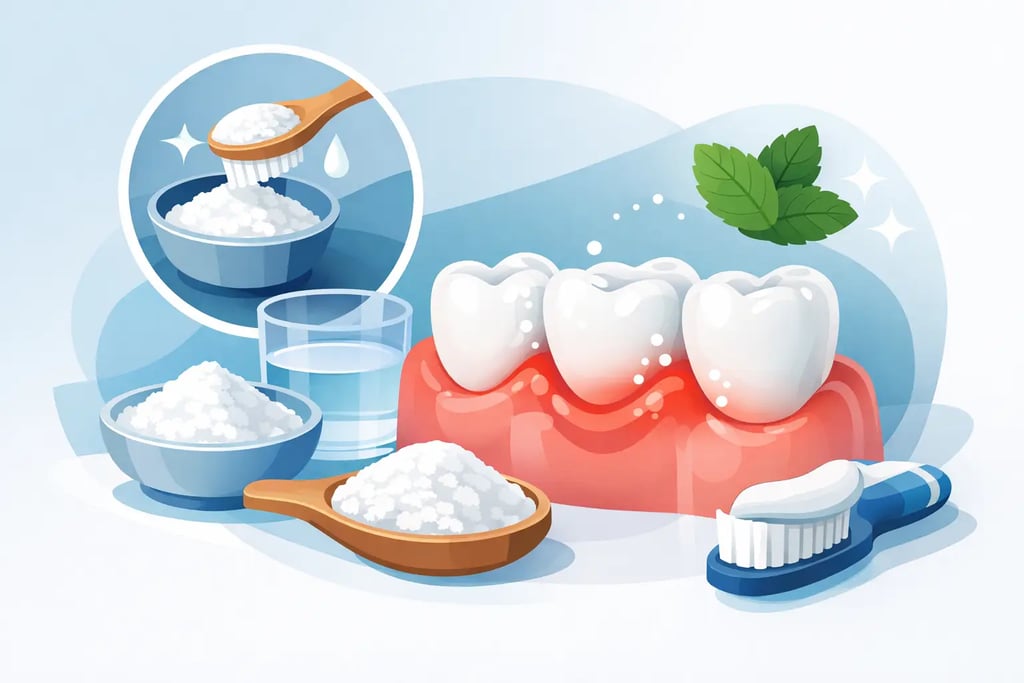
If your gums bleed when you brush, you notice sensitivity, or you see redness along the gum line, it's logical that you would look for a quick remedy. The problem is that the use of baking soda for inflamed gums has been oversimplified: some present it as a universal home solution, while others dismiss it without nuance. The reality, as almost always in oral health, depends on the cause of the inflammation, on how it is used, and above all, on whether you are trying to soothe the symptom or resolve the root cause.
Baking Soda for Inflamed Gums: What It Can Really Do
Baking soda has properties that explain why it has been present in oral care for decades. It helps neutralize acids, temporarily modifies the pH of the mouth, and can contribute to creating an environment less favorable to certain bacterial imbalances. Furthermore, when properly formulated, it can aid in cleaning the tooth surface without resorting to harsh agents.
That said, it's one thing for baking soda to be useful, and quite another to turn it into an improvised remedy for any irritated gum. The gum doesn't become inflamed for no reason. It becomes inflamed due to plaque buildup, traumatic brushing, hormonal changes, dry mouth, tobacco use, defective dental restorations, or established periodontal disease. If you can't distinguish between mild irritation and a real periodontal problem, any "natural remedy" falls short.
In mild cases, baking soda can provide indirect relief if it helps maintain cleaner, less acidic hygiene. But it doesn't act as a magic patch. It doesn't regenerate tissue on its own, nor does it replace professional evaluation when there is persistent pain, strong bad breath, tooth mobility, or repeated bleeding.
The Most Common Mistake: Using Pure, Harsh Baking Soda
Here is the point that almost no one explains well. Baking soda itself is not the problem. The problem is usually how it is used. Many people wet their toothbrush, dip it into pure baking soda, and scrub hard on already sensitive gums. This repeated action can worsen mechanical irritation.
When a gum is inflamed, it needs plaque control and gentle cleaning. If you add excessive friction, pressure, and a poorly managed texture, you can aggravate the redness. That's why it's not enough to ask whether baking soda works. You have to ask in what format, with what frequency, and with what technique.
The smart approach is not home abrasion, but biocompatible oral hygiene. That is, a simple, clean, effective formula that helps maintain the mouth's balance without anesthetizing symptoms or burdening the mucosa with filler ingredients. For years, the industry has sold foams, intense flavors, and tubes full of unnecessary compounds as if that were synonymous with health. It is not. An inflamed mouth doesn't need more artifice. It needs less aggression and more judgment.
When It Can Help and When It Cannot
If the inflammation is mild and associated with recent plaque, baking soda can be a useful support within a well-designed routine. It can promote a feeling of cleanliness, help balance pH, and reduce the acidic environment that irritates tissues. It can also fit well for people seeking simpler oral hygiene free from questionable ingredients.
However, if the gum is very painful, receding, oozing, or bleeding daily, relying on baking soda is too little, too late. In those cases, you need to consider established gingivitis or periodontitis, and that requires a diagnosis. You should also be careful if you have ulcers, open wounds, or a very reactive mucosa. Even a useful ingredient can be bothersome in an already unbalanced mouth.
There is another important nuance. Some people tolerate baking soda well in fine, stable formulations, but not in grainy homemade mixtures. That difference matters. Not everything natural is well-executed, and not everything conventional is automatically better. The key lies in the formulation, not the slogan.
How to Use It Without Further Irritating the Gum
If you want to try baking soda for inflamed gums, do it wisely. You don't need to scrub harder to clean better. In fact, the opposite is usually true. Use a soft brush, gentle movements toward the gum line, and a small amount of product. Pressure should be minimal.
The smartest approach is to avoid using pure baking soda in isolation as if it were an emergency remedy. It works better when integrated into a well-formulated toothpaste, with fine particles designed for frequent use. This is where a technology like sublimated baking soda sets itself apart from simple household powder. It's not about adding baking soda for the sake of it, but about optimizing its behavior in the mouth to promote cleaning, absorption, and compatibility with gum tissues.
This is the point where a brand like Blancodent breaks with conventional tube logic. Instead of filling the routine with foaming agents, preservatives, and substances the mouth doesn't need, it proposes more honest hygiene: understandable ingredients, an edible formula, and a mineral base designed to care for tooth and gum structure without punishing it. For those suffering from sensitive gums, that difference isn't marketing. It's a daily health decision.
What Often Inflames Gums More Than a Lack of Baking Soda
Let's be clear. Many gums are not inflamed because of a lack of a home remedy, but because of a combination of habits that the industry has normalized or that the user unknowingly adopts. Rapid, aggressive brushing, use of hard bristles, plaque buildup between teeth, tobacco, mouth breathing, and oral products with overloaded formulas form a perfect cocktail for maintaining irritation.
The false sensation of cleanliness also plays a role. There are toothpastes that create a lot of foam and leave a strong taste, but that doesn't mean they take better care of the gums. Sometimes foam only masks the problem. And when a person feels extreme freshness, they believe they are treating the issue, even if they still bleed every morning.
Gum health does not improve through cosmetic sensations. It improves when you consistently reduce plaque, respect the tissue, and eliminate what is unnecessary from your routine. Less spectacle, more biocompatibility.
What Signs Indicate You Should Stop Trying on Your Own
There are times when insisting on home remedies is no longer prudent. If inflammation lasts more than a week, if there is heavy bleeding, localized pain, pus, persistent bad taste, visible recession, or tooth mobility, it's time for a consultation. The same applies if you've been alternating between phases of improvement and relapse for months.
The gum warns you before damage progresses. Ignoring those signs because "it's just inflammation" is a bad bet. And here we must be firm: prevention is far cheaper than rebuilding lost periodontal support. Well-planned natural hygiene makes a lot of sense, but not as a substitute for a diagnosis when there are signs of disease.
The Right Question Is Not Whether It Works, But How It Fits Into Your Routine
The debate over baking soda has become too narrow. The relevant question is not whether it is good or bad in the abstract, but whether it is part of a coherent hygiene strategy. If you clean gently, if you take care of the interdental area, if you don't overload your mouth with unnecessary ingredients, and if you choose a respectful formula, baking soda can be an interesting ally. If you use it poorly, it can become just another impulsive gesture that solves nothing.
Inflamed gums call for less improvisation and more judgment. They call for abandoning the idea that the mouth is better cared for the more foam, perfume, or industrial chemistry the product contains. And they call for understanding that natural does not mean uncontrolled homemade, but rather intelligently formulated to work with the tissue, not against it.
If you are considering incorporating baking soda into your oral hygiene, don't look for an express solution. Look for a routine that your mouth can sustain every day without becoming irritated. That is where real change begins.
A more natural smile for a cleaner world.
Information

Contact
Useful links