Replace your tube of toothpaste with!



What toothpaste can children use
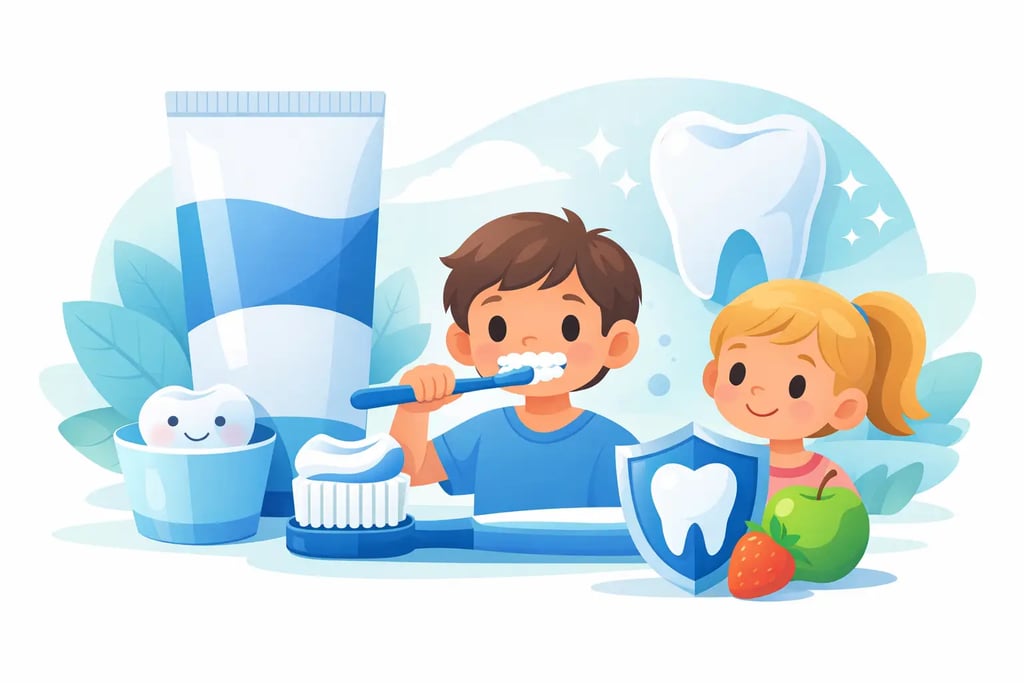
The question is not a minor one. When a child brushes, they don't just clean their teeth: they also swallow part of the product. That's why, when parents ask what toothpaste children can use, they're really raising something far more serious: what substances are entering their child's mouth and body every single day.For years, the industry has normalized children's toothpastes with intense flavors, colorants, sweeteners, foaming agents and formulas designed more to please than to respect oral biology. The problem is that a child doesn't use toothpaste the way an adult does. They suck it, taste it, swallow it in small amounts and incorporate it into a daily routine repeated two or three times a day. That detail completely changes the criteria for choosing.
Blancodent
4/25/20266 min read
"The question is not a minor one. When a child brushes, they don't just clean their teeth: they also swallow part of the product. That's why, when parents ask what toothpaste children can use, they're really raising something far more serious: what substances are entering their child's mouth and body every single day.
For years, the industry has normalized children's toothpastes with intense flavors, colorants, sweeteners, foaming agents and formulas designed more to please than to respect oral biology. The problem is that a child doesn't use toothpaste the way an adult does. They suck it, taste it, swallow it in small amounts and incorporate it into a daily routine repeated two or three times a day. That detail completely changes the criteria for choosing.
What toothpaste children can use according to their age
Not all children need the same thing, and reducing the choice to "children's" or "adult" is a dangerous oversimplification. Age, the ability to spit, the tendency to swallow the product and, of course, the actual composition of the toothpaste all need to be considered.
For babies and young children who don't yet control spitting well, the priority should be an extraordinarily clean formula. If the product is going to end up partially ingested, the logical approach is to require biocompatible ingredients and avoid aggressive or unnecessary substances. There's no sense in resorting to formulas loaded with foaming agents or questionable cosmetic components at this stage.
From around age six, many children spit better and can handle more complete routines — but that doesn't make any conventional toothpaste a good option. Childhood is still a sensitive stage, and the oral mucosa remains a direct absorption pathway. Choosing a toothpaste based solely on flavor or advertising claims is exactly the habit worth leaving behind.
What to look for on the label
If we genuinely want to answer what toothpaste children can use, we need to read the formula, not the drawing on the packaging. The label says far more than the word "junior" or "kids."
A good children's toothpaste should aim for three things: clean without aggressing, respect gums and enamel, and minimize exposure to unnecessary ingredients. It seems obvious, but it doesn't always happen. Many pastes on the market include foaming agents as if foam were synonymous with hygiene, when in reality it's only a sensory effect. In children, that experience of "lots of flavor and lots of foam" can even encourage them to swallow more of the product.
It's also worth being wary of formulas with very long ingredient lists, intense perfumes and apparently innocent additives. The more complex the product, the harder it is to justify its daily use in a child's mouth. Oral hygiene doesn't need artifice. It needs effective, respectful and consistent cleaning.
Ingredients that frequently raise questions
One of the most sensitive debates appears here: fluoride. Some families accept it; others prefer to avoid it, especially in young children who still swallow part of the toothpaste. There's no single answer for every case, because age, cavity risk, diet, brushing quality and individual professional recommendations all come into play.
What is clear is that the presence of fluoride shouldn't obscure other formulation problems. A toothpaste doesn't automatically become excellent by including one particular ingredient if at the same time it carries aggressive foaming agents, questioned preservatives or an unnecessary chemical load for everyday use.
Beyond fluoride, some parents seek to avoid strong surfactants, antibiotics, anesthetics and antifungals used repeatedly in the oral cavity. That concern isn't alarmism. It's common sense applied to a product used several times a day, from a very early age, in a zone of high absorption.
What toothpaste children can use if they swallow it
This is the decisive question. Because many children, even when they already know how to brush, continue to swallow small amounts of toothpaste. And if that happens, the approach changes: the safety of accidental ingestion stops being a detail and becomes the central criterion.
In those cases, the most reasonable formulas are those that eliminate superfluous ingredients and opt for simple, clean and non-toxic compositions. The more edible and less aggressive the product, the more coherent its use at an age when brushing control is still not perfect.
That's why more and more families are moving away from the conventional tube and looking for more honest alternatives. One of them is natural tooth powder, provided it is well formulated and not merely a trend. When the product's base is designed to respect the dentogingival structure, avoid toxins and deliver real cleaning without depending on foam or cosmetic additives, the proposition makes sense — especially for children and sensitive individuals.
In this space, Blanco Dent has put forward a direct alternative to the industrial standard with a 100% edible, fluoride-free tooth powder free from aggressive substances. That's not a minor nuance. It's a paradigm shift: stopping the assumption that traditional tube toothpaste is the only possible form of oral hygiene.
The mistake of choosing based on children's marketing
If a toothpaste looks like a sweet, that's probably not the best sign. The children's market has confused, for far too long, habit formation with the need to turn brushing into a dessert. Exaggerated flavors, eye-catching colors and textures designed to win the child over may make the routine easier, yes — but they also convey a mistaken idea: that toothpaste has to taste great in order to work.
The consequence is well known. The child sucks the brush, asks for more product than necessary and swallows a larger portion. That cycle doesn't promote more conscious or safer hygiene. The goal shouldn't be for it to taste like a sweet, but for it to clean well and not place an unnecessary burden on the body.
Some children tolerate milder flavors, less invasive formats and foam-free formulas better. In fact, when offered a more neutral experience, many adapt sooner than adults expect. Habits can also be educated.
How to choose without falling into extremes
There's no need to turn buying toothpaste into an ideological battle either. Some children have a high cavity risk, others have sensitive enamel, others wear braces and others have delicate gums. Not every case admits the same answer.
The reasonable approach is to combine caution with judgment. If a child swallows the product, a clean and safe formula should be the priority. If they also have a tendency toward cavities, the best strategy should be assessed with a professional — without assuming that the only valid option is the conventional supermarket toothpaste. The key is to personalize, not to blindly follow the shelf.
Technique also matters. An excellent toothpaste doesn't compensate for poor brushing, a sugar-heavy diet or lack of supervision. In young children, the amount should be small and brushing should be guided by an adult. This seems basic, but often the problem isn't just the product: it's using too much, too early and without oversight.
Signs that a children's toothpaste doesn't convince
There are very simple indicators that should raise red flags. If the formula depends on an extremely intense flavor for the child to accept it, if it produces excessive foam, if it leaves an artificial sensation in the mouth or if the ingredient list reads like that of a complex cosmetic, it's probably not the most respectful option available.
It's also worth observing the mouth's response. Irritation, persistent rejection, a burning sensation or more sensitive gums should not be normalized. Daily oral hygiene has to sustain health, not put it to the test.
At the same time, it's worth revisiting an inherited assumption: that "if it's sold for children, it must be safe." Not always. The children's category is often used as a marketing argument, not as a guarantee of impeccable formulation. That's why the criteria should lie in the composition and the biological logic of the product.
The right question isn't just which one, but why
Asking what toothpaste children can use forces a review of a deeply ingrained habit. For decades, conventional toothpaste was accepted without question as the standard, even though many of those formulas were designed for mass consumption rather than for maximum compatibility with a child's mouth.
Today parents have more information and less patience with opaque ingredients. And rightly so. A child's mouth doesn't need a children's version of adult chemistry. It needs effective, simple and respectful oral hygiene, with ingredients that can be looked at without suspicion.
When the choice is made from that logic, the decision becomes much clearer. Less artifice, less potential toxicity, less dependence on the same old tube and more coherence with what it means to care for a mouth that is still growing. Sometimes the best choice isn't the most famous or the sweetest, but the one that leaves fewer uncomfortable questions about what your child just put in their mouth."
Change your oral hygiene with Blancodent natural.
Our Company
© SMARTWEBDESIGN.ES 2025. All rights reserved.

Contact