Replace your tube of toothpaste with!



Natural tooth powder: is it worth it?
There's a gesture that repeats two or three times a day without much thought: open a tube, squeeze, lather and spit. The problem is that such a normalized routine doesn't always mean better care. Natural tooth powder questions exactly that automatism. Not as a trend, but as a serious alternative for those who want to clean their mouth without relying on formulas loaded with questionable ingredients. The question isn't whether the powder format sounds different. The real question is whether it improves something important. And that's where it's worth stopping looking at the packaging and starting to look at the formula.
Blancodent
4/22/20266 min read
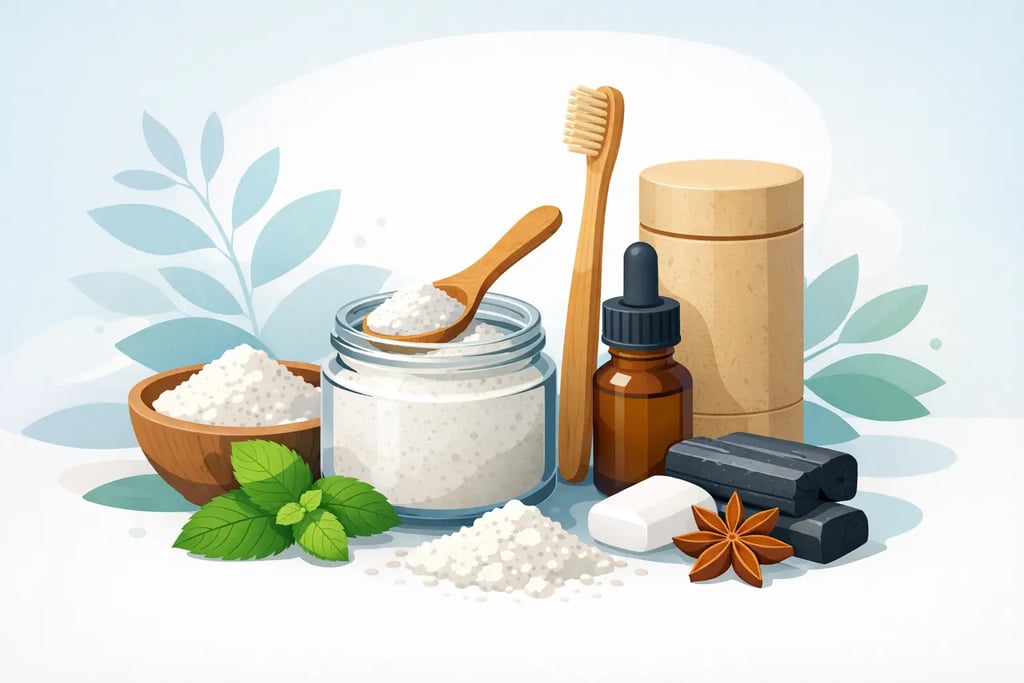
"There's a gesture that repeats two or three times a day without much thought: open a tube, squeeze, lather and spit. The problem is that such a normalized routine doesn't always mean better care. Natural tooth powder questions exactly that automatism. Not as a trend, but as a serious alternative for those who want to clean their mouth without relying on formulas loaded with questionable ingredients.
The question isn't whether the powder format sounds different. The real question is whether it improves something important. And that's where it's worth stopping looking at the packaging and starting to look at the formula.
What really changes with a natural tooth powder
Conventional toothpaste has conditioned consumers to associate effectiveness with foam, intense fragrance and creamy texture. But foam alone doesn't clean, and a tube doesn't guarantee better hygiene. In fact, many commercial formulas include foaming agents, preservatives, aggressive fragrances and other compounds that serve an industrial or cosmetic function — not necessarily one that is biocompatible with the oral mucosa.
A natural tooth powder follows a different logic. It tends to favor a shorter, more understandable composition focused on mechanical and mineral action on teeth and gums. That matters because the mouth isn't just any surface. It's living, absorbent tissue exposed daily to everything we put in it.
When a formula eliminates the superfluous, the criteria for choosing becomes more demanding. Smelling like mint and leaving a fresh feeling is no longer enough. It has to clean well, respect the gums, help maintain oral balance — and do so without carrying ingredients that many consumers prefer to avoid.
Tube toothpaste vs. natural tooth powder
The contrast isn't aesthetic. It's functional.
Tube toothpaste needs to stabilize water, maintain texture, stay preserved for months and deliver a consistent experience from first use to last. That architecture requires additives. Some are common in the industry and accepted, yes — but more and more people don't want to make a daily routine out of a blend containing foaming agents, antibiotics, anesthetics, antifungals or unnecessarily aggressive substances.
The powder format reduces that dependency. By not relying on an aqueous phase like traditional paste, it simplifies the formula and allows several typical tube components to be left out. For a consumer who prioritizes transparency, that's not a minor detail. It's part of the change.
That said, not every powder is automatically better. This is one of the most common mistakes. There are mediocre tooth powders, just as there are conventional pastes that are more carefully formulated than others. The difference lies in the quality of the mineral ingredient, its ability to interact with the oral environment, and the balance between cleaning, abrasiveness and gingival tolerance.
The ingredient matters more than the format
When discussing natural tooth powder with real criteria, we have to talk about the key mineral. Baking soda is one of the best-known active ingredients in natural oral care, but not all baking sodas behave the same way. Particle size, purity and processing method completely change its performance and tolerability.
A formulation based on sublimated baking soda, for example, makes a meaningful difference. By modifying the physical behavior of the ingredient, it improves absorption and interaction with the dentogingival structure. This can translate into effective cleaning with a finer feel and a gentler action than coarse or poorly integrated baking soda.
This detail matters because one of the most common objections to tooth powder is the fear that it will "scratch." It's a legitimate concern, but it depends on the specific product. A poorly calibrated homemade mixture is one thing; a formulation developed for daily use, with controlled texture, dispersion and behavior in the mouth, is quite another.
What drives people to leave the tube behind
Those who switch from conventional toothpaste to natural tooth powder rarely do it on a whim. They do it because they distrust a model of oral hygiene that has made chemical complexity synonymous with normality. And because they understand that the mouth deserves the same level of scrutiny as food or skincare.
Four motivations tend to drive that change. The first is the perceived safety of an edible or biocompatible formula. The second is the rejection of ingredients considered toxic or unnecessary. The third is the desire for effective cleaning without aggression. And the fourth is a preventive mindset: not waiting for a problem to arise before questioning what is used every day.
For many families, a decisive factor also comes into play: whether the product can be a safer option for children or sensitive individuals. It doesn't mean there's one single toothpaste that works for everyone, but the logic of "if a little gets swallowed, it's fine" carries real weight when compared to harsher or harder-to-justify formulas.
When natural tooth powder is worth it
It's worth it when the goal isn't just brushing teeth, but stopping the daily exposure of the mouth to a long list of ingredients that offer no clear benefit to oral tissue. Also when there is sensitivity to certain pastes, an aversion to foaming agents, or an interest in a cleaner routine more in line with a natural lifestyle.
It can be especially worthwhile for people with sensitive gums, for users tired of the chemical sensation of many commercial pastes, and for those who value simple but technically well-executed formulas. It also tends to resonate with consumers who have already reviewed what they eat, what they apply to their skin, and what comes into daily contact with their body.
But something uncomfortable needs to be said: buying a powder and expecting miracles isn't enough. Oral hygiene still depends on brushing technique, frequency, diet and the existing condition of teeth and gums. A good toothpaste helps a great deal, but it doesn't replace consistency or correct poor habits on its own.
What to look for before choosing a natural tooth powder
The first thing to examine isn't the marketing — it's the formula. It's worth checking whether the ingredients are few, recognizable and consistent with the product's promise. If it claims to be natural but carries unnecessary additives, the proposition loses its force.
It also matters whether the brand clearly explains why each ingredient is used and what function it serves. When a formula claims to strengthen the dentogingival structure, it should be able to back that up with understandable technical reasoning. A chemistry treatise isn't needed, but real transparency is.
Another key point is the experience of use. A good tooth powder shouldn't feel like dirt or leave an uncomfortable sensation. It needs to integrate well with saliva, clean clearly and leave the mouth feeling fresh — not punished. If the experience is unpleasant, users will give up quickly, even if the theory is sound.
And then there's the professional factor. For a discerning audience, the endorsement of dentists or healthcare professionals adds an extra layer of trust. Not because a white coat should replace personal judgment, but because oral hygiene needs arguments that go beyond the slogan.
The mistake of confusing natural with inadequate
Part of the industry has successfully planted a very convenient idea: that natural products clean less effectively, offer less protection or belong to the realm of the alternative without rigor. That framing no longer holds so easily.
Natural doesn't mean weak. At its best, it means a smarter, cleaner formulation more aligned with how the body works. The market may be full of poorly designed natural products — but that problem doesn't invalidate the approach. It simply requires separating the serious from the opportunistic.
When a natural tooth powder is well formulated, it can deliver visible cleaning, a sense of oral health and support for gingival balance without resorting to a cascade of aggressive ingredients. And that possibility deserves attention — especially if for years it has been accepted as normal to introduce into the mouth compounds that many people would not want in any other product used daily.
A small but daily revolution
Oral hygiene doesn't change through grand speeches. It changes through repeated decisions. That's why the format matters less than the awareness behind the choice. If a product allows you to clean, strengthen and care for your mouth from a safer, less industrial standpoint, this isn't a niche indulgence. It's a course correction.
Brands like Blanco Dent have understood something that mass-market cosmetics still tries to obscure: we don't need more foam, more fragrance or more artifice. We need formulas that respect the mouth, tell the truth and work.
If you've long suspected that the same old tube doesn't have to be the only answer, you probably don't need a spectacular promise. All you need is an honest question: if you can take care of your mouth with less chemical load and more discernment, why keep doing what you've always done?
Change your oral hygiene with Blancodent natural.
Our Company
© SMARTWEBDESIGN.ES 2025. All rights reserved.

Contact