Replace your tube of toothpaste with!



How to brush with powdered toothpaste
If you've spent years using tube toothpaste, learning how to brush with tooth powder doesn't require relearning everything — but it does mean correcting several habits that the industry has normalized. The first is believing that more foam means more cleaning. It doesn't. Real cleaning depends on the correct contact between the brush, the product and the tooth surface, not on a showy lather that often just masks the sensation of hygiene. A well-formulated tooth powder isn't there to "look like" a conventional toothpaste. It's there to work differently. And that difference matters: fewer superfluous ingredients, less unnecessary chemical load and oral hygiene more consistent with what enters your mouth two or three times a day, every day.
4/22/20265 min read
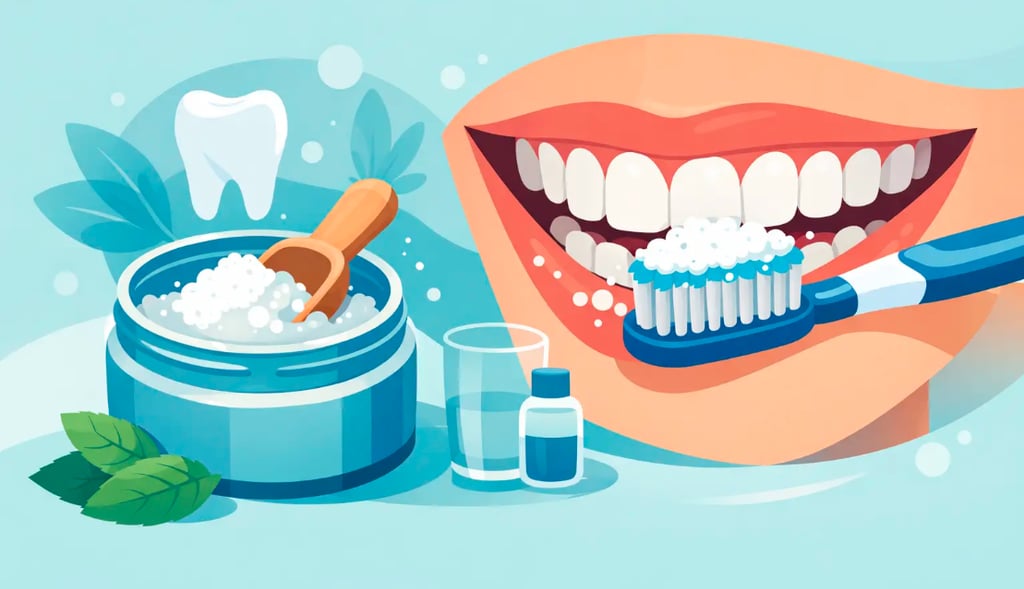
"If you've spent years using tube toothpaste, learning how to brush with tooth powder doesn't require relearning everything — but it does mean correcting several habits that the industry has normalized. The first is believing that more foam means more cleaning. It doesn't. Real cleaning depends on the correct contact between the brush, the product and the tooth surface, not on a showy lather that often just masks the sensation of hygiene.
A well-formulated tooth powder isn't there to "look like" a conventional toothpaste. It's there to work differently. And that difference matters: fewer superfluous ingredients, less unnecessary chemical load and oral hygiene more consistent with what enters your mouth two or three times a day, every day.
How to brush with tooth powder step by step
The technique is simple, but it's worth getting it right from the start to notice the difference. There's no need to soak the brush or fill your mouth with product. In fact, one of the most common mistakes when starting out is using too much.
Moisten the brush slightly. Just slightly. If you wet it too much, the powder clumps before reaching the tooth and you lose part of its ability to distribute evenly. Then, touch the powder with the tips of the bristles, or place a small amount on a clean surface and pick up the dose from there. The idea isn't to load the brush as if it were a thick paste, but to coat it lightly.
Once that's done, brush with gentle, methodical strokes. Start with the outer surface of the teeth, continue with the inner surface and finish with the chewing surfaces. At the gum line, tilt the brush about 45 degrees to follow the gingival margin without irritating it. If you press too hard, it doesn't matter whether you're using powder or paste: the problem will be poorly executed mechanical friction.
The recommended time remains the same as sensible professionals advise: around two minutes. Not out of empty habit, but because less time usually means poorly worked areas. When you're done, spit out the excess. You can rinse lightly or not at all, depending on your preference. Many people prefer not to immediately wash away all the product's components, allowing them to remain in contact with teeth and gums a little longer.
The mistake of using it like conventional toothpaste
This is the cultural clash. Tube toothpaste has conditioned entire generations to think that brushing requires a thick line of product, abundant foam and an intensely artificial flavor to be effective. That commercial script has worked very well for selling, but not necessarily for better oral care.
With tooth powder, less is more. The dose is usually small because you don't need cosmetic fillers to cover the brush. You also don't need foaming agents to feel that it's "doing something." What you need is a clean formula, well-controlled abrasiveness and correct brushing technique.
It's also worth letting go of another habit inherited from the tube: brushing quickly because the product "is already doing its job." It isn't. No toothpaste compensates for poor brushing. Powder can offer a more honest experience, because it forces you to pay attention to the real mechanics of cleaning. And that, over time, tends to translate into better habits.
How much to use and how often
The right amount is usually minimal — just enough to coat the surface bristles of the brush. If the brush looks coated in powder, you've probably used too much. Excess doesn't improve the result and only wastes product.
As for frequency, the standard is two or three times a day, just as with any serious oral hygiene routine. The difference lies in the composition. When a formula avoids aggressive substances, unnecessary foaming agents or questionable components for such repeated use, the daily routine stops being a constant exposure to ingredients that many consumers are no longer willing to normalize.
For children, people with sensitive gums or particularly reactive mouths, the same principle applies: a small amount, a soft brush and controlled movements. Safety depends not only on the product, but on how it's used.
What it feels like at first and why it doesn't resemble the tube
The first few times may feel strange. Less foam, a different texture and a final sensation that is cleaner and drier — less "coated." That doesn't mean it cleans less. It means it lacks the classic staging of industrial toothpaste.
In fact, many people notice something very specific when they switch: the mouth stops depending on aggressive flavors to perceive freshness. And that's a good sign. Real freshness shouldn't mean numbing the oral cavity sensorially — it should mean leaving it clean, balanced and free of unnecessary residue.
If you miss the foam at first, give it a few days. It's a habit, not a physiological need. Foam has been one of the biggest sensory tricks in mass oral care.
How to brush with tooth powder without damaging enamel
This point deserves clarity, because there is a lot of deliberate confusion around it. Not every powder is automatically good, just as not every tube toothpaste is automatically bad. What matters is the formula and how it's used.
A poorly designed tooth powder, with inadequate particles or uncontrolled abrasiveness, may not be the best option. But an advanced formula, designed to clean without causing damage, changes the picture entirely. This is where the quality of the ingredients and their actual behavior in the mouth come into play. That's why it makes no sense to lump together any homemade dental powder, any improvised mixture and a tooth powder developed with technical criteria.
Furthermore, enamel damage tends to come more from aggressive brushing, excessive pressure and the use of hard bristles than from the format of the toothpaste. If you use a soft brush, don't press hard and work in sections, the risk decreases considerably. Smart hygiene isn't about scrubbing harder. It's about cleaning better.
Why more and more people are leaving the tube behind
Because the tube no longer convinces those who read labels. When you discover that your daily toothpaste may contain foaming agents, preservatives, intense flavorings and other compounds that are hard to justify in an area as permeable as the mouth, you start to see the ritual differently.
The appeal of tooth powder isn't an aesthetic trend or nostalgia for an old apothecary. It's a logical response to a current demand: simpler, more transparent formulas that are more compatible with conscious oral hygiene. If the product is also edible, free from aggressive ingredients and designed as a genuine replacement for the tube, the proposition stops being an alternative and becomes an evolution.
That said, not every user is looking for the same thing. Some prioritize an intensely minty sensation. Some are looking for a fluoride-free formula. Some need, above all, a product that doesn't put them off through taste or texture. That's why the switch works best when it's not framed as an exotic gesture, but as a practical improvement to the daily routine.
What to expect after the first few weeks
Reasonably, you should notice very effective cleaning, less residue sensation and a more understated routine. Some people find their teeth feel smoother to the touch. Others value above all the peace of mind of not using a blend of questionable ingredients every day simply because that's always been the norm.
In especially well-crafted formulas — such as those incorporating sublimated baking soda to improve absorption and support the dentogingival environment — brushing stops being just about "cleaning the surface." It becomes part of a broader strategy for oral balance. That's where products like Blanco Dent set themselves apart from conventional toothpaste and from other less refined dental powders.
No fanaticism is needed to see it. It simply takes observing one straightforward fact: if a product enters your mouth every day, it should be impeccable in safety, sensible in composition and effective in results.
Changing format isn't the ultimate goal. The goal is to stop accepting chemically loaded oral hygiene as normal. If you brush with attention, with a clean formula and with discernment, tooth powder doesn't complicate your routine — it finally puts it where it belongs.
Change your oral hygiene with Blancodent natural.
Our Company
© SMARTWEBDESIGN.ES 2025. All rights reserved.

Contact